Virginia Sea Grant Launches Coastal Resiliency Adaptation and Innovation Ecosystem With a Site Tour and Technology Demonstrations

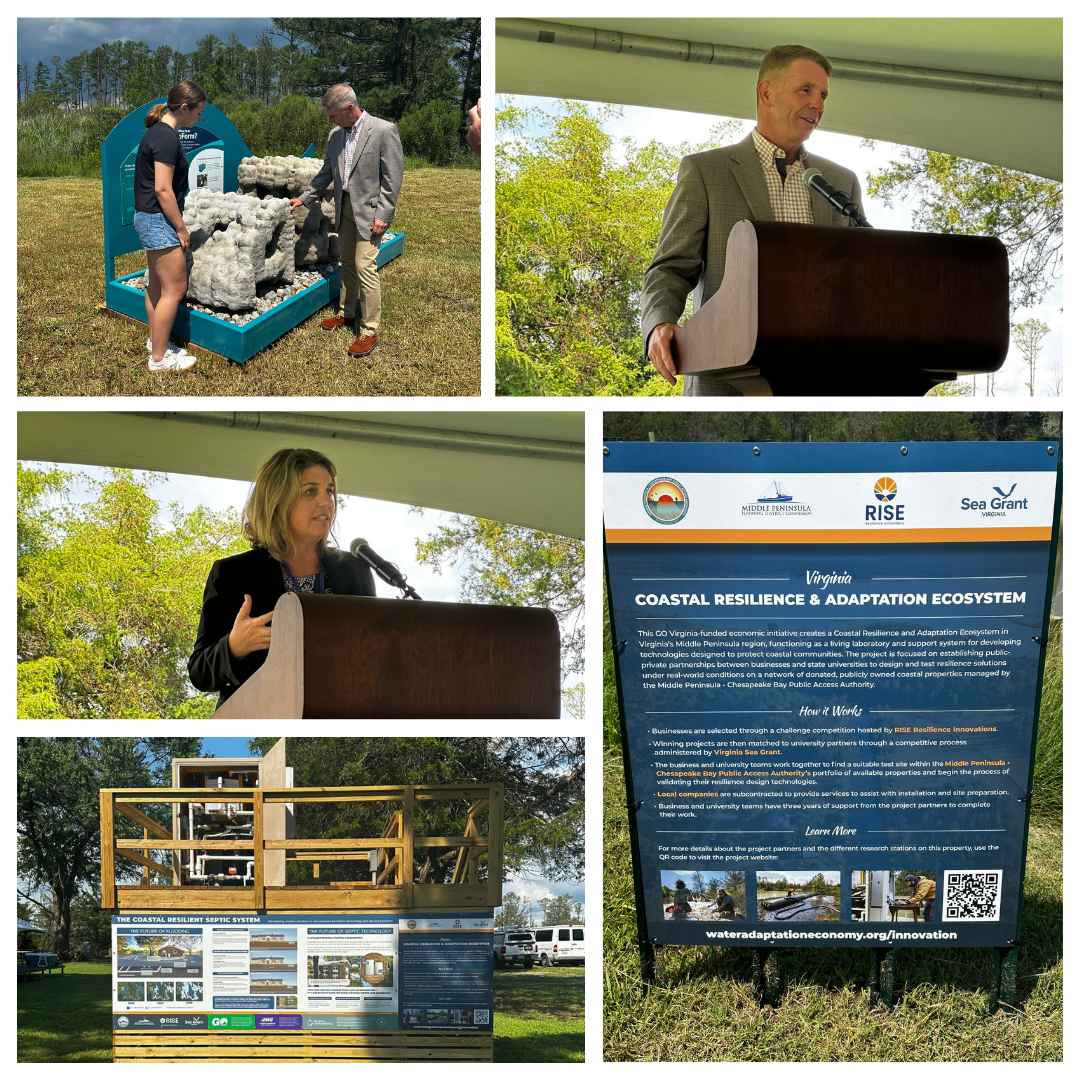
On August 12th, Virginia Sea Grant along with Rise Resilience Innovations and the Middle Peninsula Chesapeake Bay Public Access Authority held a Launch and Site Tour for their Coastal Resilience and Water Adaptation Ecosystem project. The event showcased innovative technologies developed by companies chosen for Rise’s rural challenge. As part of the project, the companies have been paired with University partners to research and develop solutions designed to protect coastal communities from shoreline erosion and flooding. 

NATRX Adaptive InfrastructureBiogenic Solutions Consulting, LLC, and Triangle Environmental Health Initiative were all present to demonstrate the innovative products they have developed using the Middle Peninsula Chesapeake Bay Public Access Authority properties serving as living laboratories for research and development. University partners include George Mason University, James Madison University, Norfolk State University, Old Dominion University, Tulane University, and the University of Virginia. 

The event kicked off with a welcome from Virginia Sea Grant’s Director, Dr. Troy Hartley, followed by comments from DHCD’s Deputy Director of Economic Development and Community Vitality, Sara Dunnigan, and Congressman Rob Wittman. Attendees then rotated around the Captain Sinclair Field Station visiting each company, as well as Knott-Alone Hold Fast (a non-profit partner working with Veterans), to witness the research and technology that’s being deployed.

The Water Adaptation Industry Cluster & Innovation Ecosystem has three main pillars: Supporting Entrepreneurs through taking products and solutions to market, Collaborative R&D through an innovation & Idea Incubator with University partners, and workforce development by creating jobs and implementing solutions. These efforts are possible through collaboration between multiple stakeholders.

To learn more about the project visit https://wateradaptationeconomy.org/.

Stafford County EDA Completes the Expanding Smart Community Testbed Project

The Stafford County Economic Development Authority recently completed their “Expanding Smart Community Tech Entrepreneurship Across Region 6” project. The GO Virginia Region 6 funded project was in partnership between Stafford EDA, the Town of Colonial Beach, Middlesex County, and RIoT. Goals or the project included a feasibility study to identify opportunities to expand the existing Smart Technology Entrepreneurial testbed into rural localities across GO Virginia Region 6. By leveraging the Virginia Smart Community Testbed in Stafford, the Stafford EDA was able to explore the need for technology-driven solutions and connecting smart technology entrepreneurs and startups with local challenges across Region 6.

To start, discovery sessions were organized with community members and leaders in the Northern Neck and Middle Peninsula to collect and document specific issues faced by the localities. Participants in these sessions discussed how Smart Technology solutions could help alleviate these problems. The following problems statements were identified:

  • Air Qualify Monitoring
  • Digital Divide (Broadband/Connectivity
  • Healthcare
  • Overfilled Landfills
  • Littering
  • Smart Mobility (Pedestrian, Parking, and Traffic Management)
  • Water/Wastewater Monitoring & Management

The second phase of the project included a call for solutions sent out to technology companies inviting submissions from entrepreneurs, startups, and established companies interested in collaborating with communities to address challenges through novel tools and concepts. A total of 28 submissions were received and evaluated based on their innovative merit and potential contributions to regional economic growth. From these, 14 submissions were chosen to advance. The project team facilitated meetings with submission winners and local government officials, focusing on practical application demonstrations and anticipated socio-economic outcomes. 

The final phase brought the local government personnel together with identified potential technology solutions by facilitating meetings with companies whose submissions were chosen. These meetings took place in Colonial Beach and Middlesex County.

Following these three stages, a final feasibility study was completed by the project team which was presented to the Stafford EDA and the GO Virginia Region 6 Council. The final report can be found here. The report identified a need for future implementation efforts in order to facilitate communication between the localities and companies, and to enable the companies to pilot their innovative technologies to provide solutions that will benefit the entire region.