Westmoreland County was recently awarded $100,000 by the Growth and Opportunity Funds (GO Virginia) Region 6 Council for a “Northern Neck Sites Inventory” planning grant. The grant funding will be used to conduct a coordinated sites inventory and prioritization for both Westmoreland and Lancaster Counties in partnership with the Towns of Colonial Beach, Montross, and Kilmarnock. Site Development is one of the four investment themes eligible GO Virginia funding. The GO Virginia Region 6 Council, which covers Planning Districts 16, 17, and 18, has identified site identification as one of its top priorities in its 2025 Growth and Diversification Plan.
The goal of the project is to provide a pipeline of developable commercial sites in the Northern Neck. Approximately 20 sites in total will be reviewed during the inventory process to include an assessment of site conditions and potential. An additional analysis will be conducted for each site to chart a path to “Tier 4” in the Virginia Business Ready Sites Program (VBRSP).
According to the Virginia Economic Development Partnership (VEDP), the VBRSP “is a discretionary program to promote development and characterization of sites to enhance the Commonwealth’s infrastructure and promote its competitive business environment.” The purpose of Tier 4 or 5 classification of the site is to attract businesses in Manufacturing, Forestry/Wood Product/Paper; Aquaculture/Seafood/Marine Industries, Distribution/Logistics, and Professional Services industry clusters.
“This announcement is a critical first step in expanding economic opportunity in Westmoreland County. By building a clear, data-driven picture of where our best development sites are—and what it will take to make them ready—we are laying the groundwork for private investment and a stronger local tax base. This is not about speculation; it is about doing the homework now so that when a good company calls tomorrow, we can say ‘yes’ with confidence,” stated James P. Taylor, County Administrator for Westmoreland County
“What makes this effort especially powerful is the partnership behind it. Westmoreland County is working side-by-side with Lancaster County, the Towns of Colonial Beach and Montross, our regional GO Virginia partners, the Virginia Economic Development Partnership, and technical experts to align land use, infrastructure, and marketing into one coordinated plan,” said Westmoreland County Economic Development Director, Dale Hendon. “That collaboration ensures we are not competing against each other locally—we are competing as a region and winning together.”
Match for the grant in the amount of $50,000 leveraging staff time and GIS technology is being provided by Westmoreland County, Lancaster County, the Town of Montross, and the Town of Colonial Beach making this a $150,000 total grant program.
The Middlesex County Economic Development Authority was recently awarded $99,840.00 in Growth and Opportunity (GO Virginia) Funds in Region 6 for the “River to Table – Blue Catfish Study.” The grant funding will be used to conduct a study to provide an initial summary of the state of the Blue Catfish industry. This includes harvesters, processors, and wholesale/retail sale in the Middle Peninsula and Northern Neck regions. The study will outline options, establish priorities, and estimate probable costs for implementing findings and recommendations to promote, support, and expand businesses associated with Blue Catfish. The final study will identify actionable strategies that can then be used to apply for implementation funding.
“The GO Virginia Region 6 Council recognizes our unique position to address the overpopulation of Blue Catfish in our waterways, and exploring the economic benefits that Blue Catfish could bring to the Northern Neck, Middle Peninsula, and other regions of the Commonwealth,” stated John Anzivino, Chair of the Region 6 Council. “We also recognize the imperative need to partner with other regional and statewide stakeholders to create a coordinated action plan to promote an economy around Blue Catfish. Brining the current population of Blue Catfish under control is also key to protecting our existing commercial fishing and aquaculture industries.”
Blue Catfish is an invasive species to the Chesapeake Bay and the bay’s estuary system, including the Rappahannock, Potomac, and James Rivers. The species was introduced into Virginia Rivers in the 1970’s for the purpose of sportfishing. The population has since grown exponentially with no natural predators and is affecting populations of blue crabs, striped bass, and other native species that have economic and historical significance. Blue Catfish typically grows less than two feet long but can grow as large as 5.5 feet and weigh 100 lbs with a lifespan of 20 to 25 years. The fish is considered to be delicious and has nutritional value, as highlighted by Virginia Seafood.
There have been several efforts by the Commonwealth to address the Blue Catfish crisis, including a workgroup run by the Virginia Department of Agriculture and Consumer Services (VDACS) and an Agriculture & Forestry Industries Development Fund (AFID) grant which had previously been awarded to Sea Farms in Gloucester, VA. The Middlesex EDA will engage both the VDACS workgroup as well as representatives from the Virginia Economic Development Partnership (VEDP), Virginia Tech, the Rivers Region Entrepreneurship Council, and the Virginia Institute of Marine Science.
Match for the grant in the amount of $62,590.00 is being provided from the Economic Development Authority (EDA) in Middlesex, Essex, Gloucester, King George, Lancaster, and Mathews County who will all be represented on the grant advisory committee.
REEDVILLE – Omega Protein recently presented a check for $250,000 to the Greater Reedville Association toward the restoration of Festival Halle, a cherished landmark on Main Street in the village.
“With deep roots in Reedville’s maritime heritage dating back to 1878, we are honored to support an organization whose mission is to preserve and share the rich history of our community,” according to Nick Sterrett, vice president of sales for Omega Protein. “We are grateful to be part of an organization like Cooke Seafood, who makes it their mission to strengthen the communities in which they operate.”
The building now called Festival Halle served as Reedville High School from1927, then later as a primary school. The building was donated to the association in 2009 by the Birkel family.
The building is undergoing an extensive renovation, with completion scheduled for early 2026.
Omega Protein’s donation will serve as a partial match for the $280,800 GO Virginia grant recently awarded to the association. GO Virginia is a state-funded initiative, administered by the Virginia Department of Housing and Community Development, that strengthens and diversifies Virginia’s economy and fosters the creation of higher wage jobs in strategic industries.
The grant will help establish an aquaculture and maritime innovation incubator program that will be headquartered in Festival Halle. The total budget for the incubator project is $524,385.
“Corporate, community and local government donations have made it possible to acquire the necessary grant funding to undertake such a large project,” said Shauna McCranie, executive director of the Reedville Fishermen’s Museum, which also is under the umbrella of the Greater Reedville Association.
A key part of the project will be to install a fully equipped and certified commercial kitchen, so local watermen and food entrepreneurs can process and package seafood for regional markets, according to Bruce Samuelsen, treasurer of the association.
The project includes workforce training and education (food safety, business finance, marketing and human resources) and supporting entrepreneurs through outside partnerships.
The goal is to create at least 80 jobs in five years, with $1 million annual economic impact; enable direct-to-market seafood sales, boosting revenue for local watermen; and provide training to support long-term economic development in the region.
Participating localities include Northumberland County and Lancaster County, but the project is open to watermen across the Northern Neck and Middle Peninsula, according to Sarah Oldaker, GO Virginia’s Region 6 Program Director.
“The Region 6 Council is proud to support a unique project that focuses on the shellfish growers, commercial fishermen and agricultural producers in the region. These industries have historical and cultural significance and provide important economic impacts for area localities and the Commonwealth. The vision for this project serves as a catalyst for a larger scale-up effort in these industries in both the Northern Neck and Middle Peninsula. Supporting these industries and expanding their markets outside of Virginia is a key piece of our growth and diversification plan for Region 6,” said John Anzivino, chair of the GO Virginia Region 6 Council.
“The Greater Reedville Association is excited to provide watermen with the ability to grow and market their businesses locally,” said McCranie. “We look forward to partnering with the local watermen community to have a space where they can package their seafood, learn valuable business skills and develop relationships with other leaders in the industry.”
University of Mary Washington’s Office of Continuing and Professional Studies has been awarded a GO Virginia Region 6 grant to support the development and launch of a new Practice Management Certificate Program. This initiative marks the first GO Virginia grant awarded in the healthcare cluster in the Commonwealth, with the program positioned to be a model for the region and for the state.
“UMW has been one of the leaders in workforce development for the region’s healthcare sector, and this grant expands that work and opportunity, in partnership with local healthcare leaders. It shows our shared focus on investing in a healthy community and in a well prepared, flexible healthcare workforce across all of Region 6,”said Director of Continuing and Professional Studies Teresa Segelken.
“The GO Virginia Region 6 Council is proud to have successfully submitted the first GO Virginia planning grant application focused on healthcare to the state GO Virginia Board. With approval of this grant and by working with the University of Mary Washington we will be increasing the amount of qualified healthcare workers in the region, which, in turn, will support the growth of our targeted industry sectors. This project will not only pilot a new program for Practice Management Certification but will also provide necessary research and data on the need of healthcare professionals to support the economic growth of the entire region,” said GO Virginia Region 6 Council Chair John Anzivino.
The $78,000 grant will fund a two-phase initiative. The first phase, beginning in the coming weeks, will focus on research to assess how the current healthcare infrastructure impacts business growth and development across Region 6. The second phase will pilot a credentialing course for Medical Office Managers, designed to enhance the operational efficiency of medical practices and improve access to care. The course is expected to open for registration in spring 2026 through UMW’s Continuing and Professional Studies webpage. The Practice Management Certificate will be in partnership with the Practice Management Institute, a nationally recognized credentialing body.
UMW’s Continuing and Professional Studies will leverage its expertise in business acumen to ensure participants leave the program as experts in running and leading efficient medical offices. The GO Virginia grant will fund the program director, researcher, adjunct instructors, general classroom materials and marketing of the program. Mary Washington Healthcare provided the required non-state financial match for the grant, underscoring the strong regional support for the program from healthcare providers, businesses and local governments.
“This partnership between Mary Washington Healthcare and the University of Mary Washington, supported by GO Virginia, represents a powerful step forward in strengthening our region’s healthcare infrastructure,”said Mary Washington Healthcare SVP and Chief Human Resources Officer Joanne Huber-Sturans. “By upskilling practice managers, we’re not only improving day-to-day efficiency and patient access, but we’re also investing in a healthier, more resilient community, which lays the groundwork for long-term economic growth across our community.”
The Department of Housing and Community Development (DHCD) administratively approved two planning grants in GO Virginia Region 6. The Region 6 Executive Committee had previously approved the two planning grants, totaling $171,926.00, to be submitted to DHCD at their December 12th, 2024 meeting. GO Virginia planning grants are awarded to planning and pilot projects which are intended to build regional capacity for project development and implementation. Regions are limited to allocating $250,000 per fiscal year towards planning grants, and each individual planning grant must not exceed $100,000 in the GO Virginia request.
Cyber Bytes Foundation| Cyber Titans Virginia Internship Program (Cyber Titans VIP)
The Cyber Bytes Foundation was awarded $99,826 in Region 6 per capita funds for their Cyber Titans Virginia Internship Program (Cyber Titans VIP) with $49,913 in match and $147,325.64 in leveraged funds. The pilot program will strategically develop Cyber Titans VIP as an internship program to prepare high school and college students, transitioning service members, and individuals seeking careers in cybersecurity. By collaborating with industry partners, educational institutions, and regional stakeholders, Cyber Bytes will design a training curriculum and certification pathway that aligns with current and evolving industry needs. The applicant will effectively plan and pilot Cyber Titans VIP, ensuring that participants are equipped with comprehensive skills that prepare them to excel in the Cybersecurity workforce and become leaders in their chosen specialties. Project outcomes includes the creation of a long-term cybersecurity internship program with curriculum and provide a model for work-based learning opportunities in the cyber space that can be scaled. The pilot phase of the project will create 20 internships.
RIVERE Ecological Center | Ecological Center and Entrepreneurial Ecosystem Analysis
RIVERE Ecological Center was awarded $72,100 in per capita funds for their Rapp Smart River Initiative with $36,050 in match and $26,995 in leveraged funds. The planning grant will fund an economic analysis to measure the impact in the next 10 to 20 years. The study will be used to inform development of the virtual center, identify future investor partnerships, and to communicate the mission and outputs of the center to diverse audiences with a focus on potential occupants so that presale of available spaces can be achieved before construction is complete. The Project Outcome is an Economic analysis study which will be used to help develop an implementation effort.
The GO Virginia Region 6 Council announced $607,857 of Growth and Opportunity funds allocated for two projects in Region 6. GO Virginia Region 6 includes the Fredericksburg Region, Northern Neck, and the Middle Peninsula. The two projects both focus on the region’s targeted industry clusters with one concentrating on Workforce Development while the other is an Entrepreneurship Ecosystem Startup project. The workforce development project is led by the Bay Consortium Workforce Development Board (BCWDB) and will build on the Talent Pathways Initiative previously completed in 2023. The Virginia Black Chamber of Commerce (VABCC) is the recipient of the Entrepreneurship Startup Ecosystem project, implementing a business accelerator previously piloted in a GO Virginia Region 6 planning grant.
Bay Consortium Workforce Development Board (BCWDB) | Career Advancement and Resource Education (CARE)
The Bay Consortium Workforce Development Board (BCWDB) has been awarded $307,857 from Region 6’s Per Capita allocations for their Career Advancement and Resource Education (CARE) project to build new capacity, enhance career awareness, and define career pathways within the Information Technology, Aquaculture, and Manufacturing industry clusters. The CARE project will serve all 15 localities in Region 6.
The project will focus on four strategic goals:
Develop the capacity to serve as the Sector Partnership regional convenor to develop the foundation for employer-led talent development strategies through employer engagement.
Define career pathways of the targeted industries influenced by data from employers.
Address workforce development issues as larger industry initiatives to foster collaboration through the Sector Partnership Toolkit and outreach materials.
Collect and utilize data to inform collective talent development priorities and ensure actional strategies are implemented through business toolkits.
“As a convener of the workforce system in Region 6, we’re excited about implementing key findings from the Talent Pathways Initiative. We feel like this project will take a significant step in bridging the gap between the private sector, talent in the region, and our educational institutions,” commented Jackie Davis, Executive Director of the Bay Consortium Workforce Development Board. “Approval of the project signifies an investment in what will be a long term employer led and data driven approach to workforce development in the region.”
The project activities support the findings in the Region 6 Talent Pathway Initiative (TPI) Plan completed by the BCWDB in 2023. This includes finding ways to use flexible On-the-Job-Training (OJT) and work-based learning to support employment and utilization of stackable credentials to support upward job mobility. The project will also expand capacity at the BCWDB with a newly created Talent Development Coordinator position, which will lead Sector Partnerships and serve as a liaison between the business community and the broader workforce system.
The GO Virginia award is matched with $160,891 in local and federal funds. This brings the total project budget to $468,747. The core grant outcomes for the project include 60 job placements, 35 businesses served, 5 new interns placed, and 10 new apprenticeships created. In addition to the project metrics, there will also be the creation of a Business Toolkit to help the employer’s ability to recruit talent in the region and provide a skills-based hiring framework.
Virginia Black Chamber of Commerce (VABCC)| Expanding Business Ecosystems (EBE) Business Accelerator
The Virginia Black Chamber of Commerce (VABCC) has been awarded $300,000 in GO Virginia Region 6 Per Capita allocations for the Expanding Business Ecosystems (EBE) Business Accelerator. Participating localities include the City of Fredericksburg, Spotsylvania County, and Stafford County. The EBE Business Accelerator will focus on the Agriculture/Controlled Environment Agriculture, Distribution and Logistics, Manufacturing, and Professional Services industry clusters. This project is an expansion of the successful EBE Business Accelerator pilot program which was funded with a GO Virginia planning grant which closed out earlier this year.
The program will launch a ten-week program for six cohorts over two years, serving 120 businesses across Region 6. Each cohort will focus on specific industries or demographic groups that require tailored support, such as minority-owned businesses, tech startups, or companies in the manufacturing sector. Key elements of the program include the development of instructor led training modules, a sector specific mentorship program, networking events to connect industry leaders and potential investors with entrepreneurs, the creation of an advisory committee with experts and stakeholders in the region, and targeted outreach to ensure broad participation thereby increasing inclusivity and impact of the program.
“This grant is a transformational investment in the Virginia Black Chamber of Commerce’s mission to support and empower small businesses,” stated Ernisha Hall, President & CEO of the Virginia Black Chamber of Commerce. “With this funding, we can significantly expand the reach and impact of our Business Accelerator Program, fostering innovation and driving economic growth within our community. We are deeply grateful for this opportunity and are committed to using these resources to uplift entrepreneurs, strengthen small businesses, and create a more equitable and prosperous future for everyone.”
The match provided for the project totals $160,000 both from the VABCC, participating localities, and private sources. Additional leverage is being provided in the amount of $75,715 for a total project budget of $535,715. The core grant outcomes for this project include 120 businesses serviced, 120 businesses expanded, 10 new businesses created, 18 jobs created, and 30 new mentors providing business assistance.
The GO Virginia State Board along with staff from the Department of Housing and Community Development (DHCD) held the 2nd annual retreat for Regional Council leadership and support organization staff at the Institute for Advanced Learning and Research in Danville, VA. The retreat convened all 9 GO Virginia regions with State Board members to discuss successes of the program, and to look towards the future of “GO Virginia 2.0.”
Governor Glenn Youngkin spoke on Virginia’s Economic Development Priorities and how GO Virginia projects can help the Commonwealth achieve these goals through collaboration and partnership. Panelists included the Virginia Economic Development Partnership sector leads from Knowledge Work, Manufacturing, and Transportation/Logistics; representatives from Southside Virginia economic development organizations; and three Regional Council Chairs.
Shara Gibson, Program Manager for GO Virginia at DHCD, presented updated data on projects funded and metrics achieved since the creation of GO Virginia. There was also a focus on Program Performance and looking forward to GO Virginia 2.0. Some of the changes recommended from the JLARC study completed in 2023 have already taken place, such as project match being reduced to 2:1 from 1:1 and the inclusion of Healthcare as an allowable industry for project funding.
Each of the Nine GO Virginia Regions were able to showcase impactful projects at the Game Changer Reception on the first night of the retreat. Region 6 had representation from the Virginia Sea Grant’s “Launching a Coastal Resilience and Adaptation Economy” and the Virginia Tech Center for Economic and Community Engagement’s “Promoting Careers in Aquaculture 2.0” projects.
To learn more about the GO Virginia State Board and its membership, visit the DHCD website.
The Fredericksburg Regional Chamber of Commerce’s Workforce NOW program held the third annual Superintendent’s Forum on September 17th. The forum featured Superintendents and representatives from Planning District 16’s five school divisions. Dr. Antoinette Jenkins, Director of the Rappahannock Work and Learn Collaborative at the University of Mary Washington, moderated the panel with questions focused on work-based learning and Career Technical Education (CTE) programs.
Panelists discussed programs available to all students, including those not continuing on to a two-year or four-year institution, and how career exploration, work-based learning, and credentialing can help prepare those students to enter the workforce straight out of high school. “Work-based learning is really for all students, not just for students who are going to college,” said Dr. Clint Mitchell, superintendent for Spotsylvania County Public Schools. “And I want to make sure that we provide the opportunity for all kids…”
Panelists also highlighted how partnerships between the school divisions and private industry or local businesses can benefit both students and their future employers. Some of these partnerships are already in place thanks to connections made at the Workforce NOW annual Internship Expo. Examples include Partnerships between:
Mary Washington Healthcare and Fredericksburg City Schools,
CMC Rebar and King George County Schools,
SIM Ventions and Stafford County Schools,
Habitat with Humanity with Caroline County Schools
“It’s all about making sure that our partnerships are supporting a curriculum to help students experience the interests that they have, and to solidify those choices they’re making in terms of their career pathways or to maybe move them into a different direction,” Dr. Marcie Rice from Stafford County Schools stated.
The Superintendent Forum is part of the Workforce NOW programming, funded in part by GO Virginia Region 6. To stay up to date on future Workforce NOW events and to register, visit the Chamber’s website.
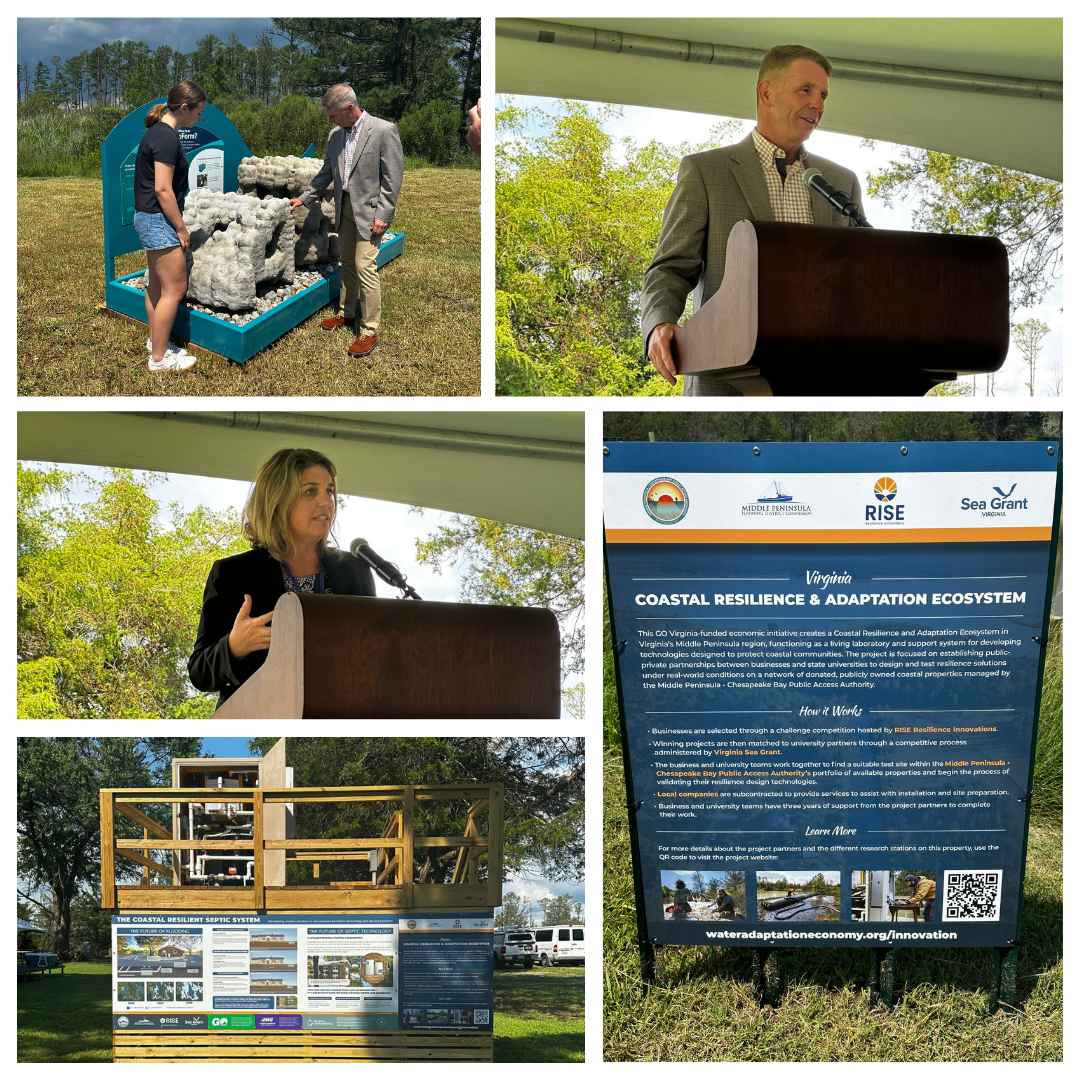
On August 12th, Virginia Sea Grant along with Rise Resilience Innovations and the Middle Peninsula Chesapeake Bay Public Access Authority held a Launch and Site Tour for their Coastal Resilience and Water Adaptation Ecosystem project. The event showcased innovative technologies developed by companies chosen for Rise’s rural challenge. As part of the project, the companies have been paired with University partners to research and develop solutions designed to protect coastal communities from shoreline erosion and flooding.
NATRX Adaptive Infrastructure, Biogenic Solutions Consulting, LLC, and Triangle Environmental Health Initiative were all present to demonstrate the innovative products they have developed using the Middle Peninsula Chesapeake Bay Public Access Authority properties serving as living laboratories for research and development. University partners include George Mason University, James Madison University, Norfolk State University, Old Dominion University, Tulane University, and the University of Virginia.
The event kicked off with a welcome from Virginia Sea Grant’s Director, Dr. Troy Hartley, followed by comments from DHCD’s Deputy Director of Economic Development and Community Vitality, Sara Dunnigan, and Congressman Rob Wittman. Attendees then rotated around the Captain Sinclair Field Station visiting each company, as well as Knott-Alone Hold Fast (a non-profit partner working with Veterans), to witness the research and technology that’s being deployed.
The Water Adaptation Industry Cluster & Innovation Ecosystem has three main pillars: Supporting Entrepreneurs through taking products and solutions to market, Collaborative R&D through an innovation & Idea Incubator with University partners, and workforce development by creating jobs and implementing solutions. These efforts are possible through collaboration between multiple stakeholders.
The Stafford County Economic Development Authority recently completed their “Expanding Smart Community Tech Entrepreneurship Across Region 6” project. The GO Virginia Region 6 funded project was in partnership between Stafford EDA, the Town of Colonial Beach, Middlesex County, and RIoT. Goals or the project included a feasibility study to identify opportunities to expand the existing Smart Technology Entrepreneurial testbed into rural localities across GO Virginia Region 6. By leveraging the Virginia Smart Community Testbed in Stafford, the Stafford EDA was able to explore the need for technology-driven solutions and connecting smart technology entrepreneurs and startups with local challenges across Region 6.
To start, discovery sessions were organized with community members and leaders in the Northern Neck and Middle Peninsula to collect and document specific issues faced by the localities. Participants in these sessions discussed how Smart Technology solutions could help alleviate these problems. The following problems statements were identified:
Air Qualify Monitoring
Digital Divide (Broadband/Connectivity
Healthcare
Overfilled Landfills
Littering
Smart Mobility (Pedestrian, Parking, and Traffic Management)
Water/Wastewater Monitoring & Management
The second phase of the project included a call for solutions sent out to technology companies inviting submissions from entrepreneurs, startups, and established companies interested in collaborating with communities to address challenges through novel tools and concepts. A total of 28 submissions were received and evaluated based on their innovative merit and potential contributions to regional economic growth. From these, 14 submissions were chosen to advance. The project team facilitated meetings with submission winners and local government officials, focusing on practical application demonstrations and anticipated socio-economic outcomes.
The final phase brought the local government personnel together with identified potential technology solutions by facilitating meetings with companies whose submissions were chosen. These meetings took place in Colonial Beach and Middlesex County.
Following these three stages, a final feasibility study was completed by the project team which was presented to the Stafford EDA and the GO Virginia Region 6 Council. The final report can be found here. The report identified a need for future implementation efforts in order to facilitate communication between the localities and companies, and to enable the companies to pilot their innovative technologies to provide solutions that will benefit the entire region.